
The short answer
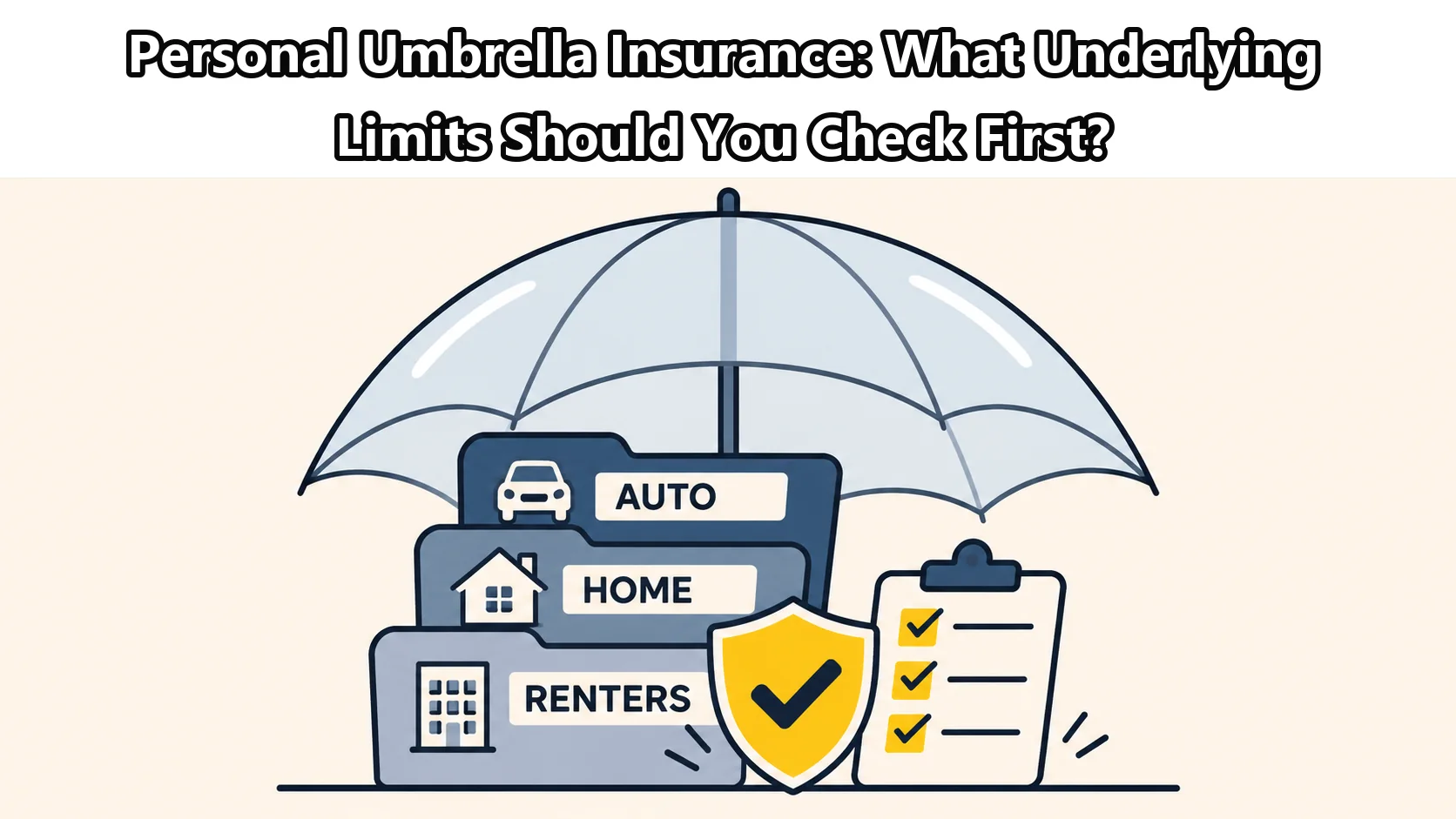
Usually, a personal umbrella policy sits above specified underlying liability coverage rather than replacing auto, homeowners, renters, boat, or other primary policies. Before applying, identify the limits the umbrella carrier requires on each underlying policy and compare those requirements with the limits you actually carry. A carrier may require higher auto or home liability limits than a state minimum, and the exact threshold can vary by insurer, state, vehicle, property, household, and risk factors.
Do not assume that buying a one-million-dollar umbrella automatically creates one million dollars of usable protection for every event. The umbrella may respond only after an underlying limit is exhausted, may follow the underlying policy’s definitions and exclusions, and may have its own retained limit or exclusion. Build a policy map before changing limits or cancelling anything. Read both layers together before purchase.
Understand what an umbrella policy sits above
A personal umbrella commonly coordinates with liability coverage on an auto policy and a homeowners or renters policy. Depending on the contract, it may also address boats, recreational vehicles, additional residences, landlords’ exposures, or personal injury claims. The list of supported underlying policies is not universal, and a personal umbrella is not a substitute for property coverage, collision coverage, health insurance, or a business policy.
Read the schedule of underlying insurance and the definitions section. Write down every policy, named insured, vehicle, residence, rental property, watercraft, and household member that the umbrella expects you to disclose. A missing policy or undisclosed activity can create a coordination problem even when the umbrella limit looks large.
Check required underlying limits
Umbrella carriers often require specified bodily-injury and property-damage limits before they will issue or renew an umbrella. The required limits may be different for auto, home, renters, boat, or other exposures. A carrier can also require that the underlying coverage be maintained throughout the umbrella term. These are underwriting and contract questions, not universal legal minimums.
Request the requirement in writing and compare it with your declarations pages. Check per-person and per-accident limits, property-damage limits, personal-liability limits, uninsured or underinsured motorist limits, and any separate watercraft or rental requirement. If the underlying limit falls below the condition in the umbrella contract, ask what happens before relying on the excess layer.
Distinguish legal minimums from umbrella eligibility
A state may set minimum auto liability limits for driving, but an umbrella carrier may require more. Meeting a state minimum can allow a vehicle to be registered while still failing the umbrella carrier’s underwriting requirement. Conversely, choosing a higher underlying limit does not guarantee that an umbrella will be available or that every claim will be covered.
Keep two columns in your comparison: “required by law” and “required by the umbrella contract.” Add a third column for the limit you actually carry. This prevents a common mistake: reducing primary liability to a legal minimum because the umbrella is being treated as if it were a replacement for the primary layer.
Map the attachment point and coverage gap
The attachment point is the point at which the umbrella may begin to respond after an underlying liability limit is exhausted or a covered loss is handled under the umbrella’s terms. A gap can appear when the underlying policy limit is lower than the umbrella requirement, when an underlying policy does not cover the event, or when an exclusion applies in one layer but not the other.
For each exposure, write the primary limit, the umbrella requirement, the umbrella limit, and the exclusions that could affect the transition. Ask whether the umbrella is true excess over that policy, whether it can drop down for a loss not covered by the primary policy, and whether a self-insured retention applies. Never infer drop-down coverage from the word “umbrella” alone.
Review auto liability and household drivers
Auto liability is a frequent underlying requirement because a serious crash can create bodily-injury or property-damage allegations. Review every vehicle, regular driver, permissive driver, youthful driver, motorcycle, recreational vehicle, and vehicle used by a household member. The declarations page may not reveal every underwriting question or exclusion.
Ask how the umbrella treats newly acquired vehicles, vehicles owned by a trust or business, rideshare use, delivery work, racing, transportation of passengers, and drivers who live elsewhere. Confirm that the auto carrier and umbrella carrier have consistent named-insured information and that a change in auto limits is reflected before the umbrella renewal.
Review home, renters, and property liability
Homeowners and renters policies provide primary personal-liability coverage under their own forms, but the underlying limits, named insureds, premises, and activities differ. A landlord, vacant home, second residence, short-term rental, pool, trampoline, dog, farm, or construction project may need separate review. A renters policy can be important even when the renter owns little property because it may provide the underlying liability layer.
List every residence and property interest and ask whether the umbrella requires the same carrier, a specific liability limit, or a particular policy form. Do not assume a personal umbrella covers a business, professional activity, or commercial property. Those risks may require business or specialty coverage with a separate liability structure.
Check uninsured and underinsured motorist treatment
Uninsured and underinsured motorist coverage addresses a different problem from liability coverage: injuries caused by another driver who has no insurance or insufficient insurance. Some umbrellas exclude excess UM/UIM coverage, while some jurisdictions or products may offer it as an endorsement. A standard umbrella should not be described as automatic protection for injuries you suffer in a crash.
Ask whether excess UM/UIM is included, excluded, or available by endorsement; what vehicles and people are covered; and what limits and conditions apply. Compare the answer with the primary auto policy. Keep this question separate from the requirement for bodily-injury liability limits.
Review exclusions and personal-injury liability
Umbrella contracts can contain exclusions for intentional acts, business activities, professional services, pollution, war, criminal acts, certain vehicles or watercraft, and other risks. Some personal umbrella products may address personal injury allegations such as defamation, libel, slander, invasion of privacy, or wrongful eviction, but the wording and exclusions control.
Read the definitions and exclusions rather than relying on a list from an agent or online article. Make a separate activity inventory for volunteering, boards, social media, rental property, childcare, coaching, firearms, animals, watercraft, and travel. Ask whether each activity is covered, excluded, limited, or requires another policy.
Disclose assets, activities, and household facts
Underwriting can consider household drivers, residences, vehicles, property ownership, rental activity, watercraft, animals, claims, business interests, and other facts requested in the application. The purpose of disclosure is not to prove that a person needs a particular limit; it is to help the carrier evaluate eligibility and terms under its rules.
Update the carrier when a new vehicle, residence, driver, rental, boat, business interest, or major activity appears. Ask how a trust, LLC, estate, or family member should be named. Do not hide a risk because it makes the quote less convenient; an application answer and the contract should be consistent.
Compare limits, deductibles, and retained amounts
Compare the umbrella limit, aggregate rules, per-occurrence wording, defense-cost treatment, self-insured retention, and any deductible that applies to an excluded or uninsured underlying loss. A high limit is only one part of the design. Some contracts may use a retained amount before the umbrella responds in a situation that the underlying policy does not cover.
Ask what counts toward the underlying limit, whether defense costs reduce the limit, whether multiple claims share an aggregate, and how related incidents are treated. Keep a copy of the quote, application, binder, policy, endorsements, and declarations pages so that the final contract can be checked against the purchase decision.
Coordinate claims and defense
When a serious liability event occurs, notice may be required to both the primary carrier and the umbrella carrier. The primary carrier may investigate, defend, negotiate, and pay up to its limit, while the umbrella may become involved when a claim may exceed that layer or falls within its separate process.
Ask for claim-reporting instructions and preserve suit papers, notices, photographs, witness information, correspondence, and underlying claim numbers. Do not admit liability, settle, or sign a release without understanding how the primary and excess policies coordinate. The defense provision and consent requirements in the actual contracts matter.
Review property, territory, and activity boundaries
Coverage can depend on where an event occurs, who is insured, what property is involved, and whether an activity is personal or business-related. A personal umbrella may have territory and residence conditions and may treat an incident outside the United States differently. A rental or commercial exposure may require another policy even if the owner also has a personal umbrella.
Write down travel, rental, second-home, boat, recreational, volunteer, and business exposures and ask the carrier to address them. Keep the answer with the policy record. A broad marketing phrase such as “worldwide protection” does not replace the territory, definitions, conditions, and exclusions in the contract.
Compare umbrella, excess, and specialty options
“Umbrella” and “excess liability” are often used together but may describe different forms or scope. A specialty product may be designed for high-value homes, multiple properties, watercraft, aircraft, rental activity, or unusual assets. A business or professional liability policy can be the correct layer for a commercial exposure rather than a personal umbrella.
Ask what policies the product follows, whether it broadens coverage or only adds limits, whether it includes defense, and what retained amount applies. Compare the form and endorsements, not just the name, limit, or premium. Provider pages in the site’s review catalog are orientation sources, not a universal recommendation or quote.
Recheck at renewal and after changes
Underlying limits and umbrella eligibility can change when a carrier changes its requirements, a household adds a driver, a property becomes a rental, a vehicle is replaced, or the policy renews under a new form. A renewal packet may contain a new exclusion, schedule, premium, or minimum limit.
At renewal, compare declarations and endorsements with the prior term. Confirm that every underlying policy is active, the listed limits meet the umbrella condition, and new exposures are scheduled. If the umbrella is cancelled or nonrenewed, ask how and when the underlying policies must be updated and do not assume a replacement is immediate.
Build a policy coordination table
Create rows for auto, home, renters, boat, motorcycle, rental property, second home, business, personal injury, UM/UIM, and any other relevant exposure. Use columns for insurer, named insured, policy term, limit, deductible, exclusion, required underlying limit, umbrella attachment point, aggregate, defense costs, territory, and document page.
Mark every row confirmed, unclear, not applicable, or awaiting a written answer. Keep the declarations pages together and save communications about required limits. This turns a vague question—“Is a million-dollar umbrella enough?”—into a documented review of the risks and layers that actually exist.
Final checklist
Before buying or renewing personal umbrella insurance, confirm the underlying limits required by the carrier, the limits you actually carry, the attachment point, drop-down or retained-limit rules, UM/UIM treatment, exclusions, named insureds, properties, vehicles, household activities, defense provisions, territory, and renewal conditions.
Then compare the final policy with the application and declarations pages. Increase or change primary limits only after understanding the contract and household risk. A quote, an online answer, or a low premium does not guarantee availability or claim payment; the policy language and current facts control.
Sources and further reading
- umbrella insurance public reference — umbrella insurance; checked 2026-10-13.
- personal umbrella insurance public reference — personal umbrella insurance; checked 2026-10-13.
- Chubb Personal Umbrella and Excess Liability Insurance — Chubb; checked 2026-10-15.
- Chubb Personal Liability Products — Chubb; checked 2026-10-15.
- Travelers Personal Umbrella Insurance — Travelers; checked 2026-10-15.
- Travelers Personal Insurance — Travelers; checked 2026-10-15.
- State Farm Personal Liability Umbrella Policy — State; checked 2026-10-15.