
The short answer
A personal umbrella policy is generally designed to provide additional liability protection above specified primary or underlying policies. NAIC explains that an umbrella may help with liability and defense costs that exceed what auto, homeowners or renters insurance would pay, while the policy wording controls the actual trigger, limits and exclusions. It is not a replacement for the underlying policies and it is not a general repair policy for your own car or home.
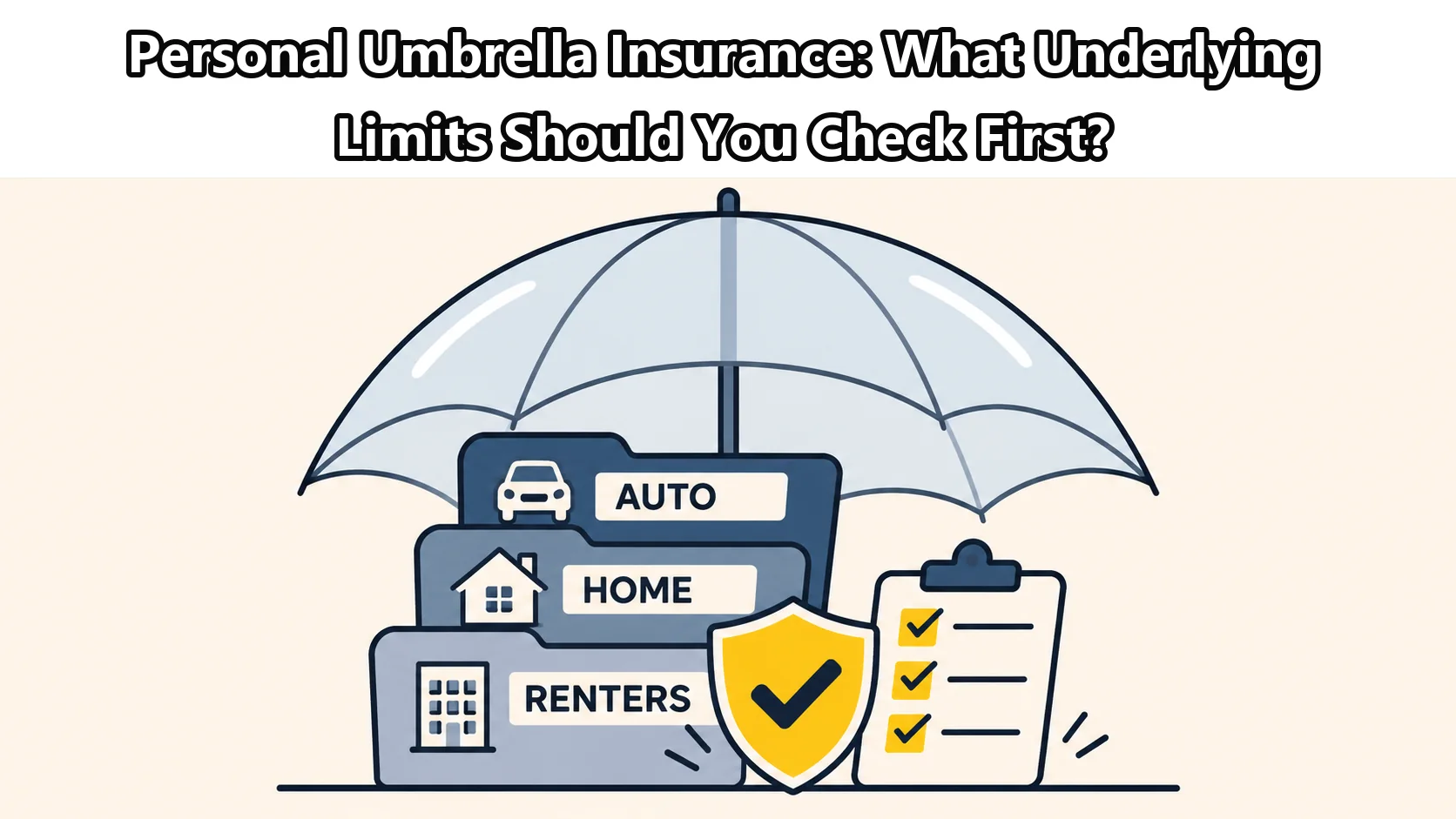
Before comparing an umbrella, make a schedule of every underlying policy, the liability limit shown on its declarations page, the named insureds, vehicles, homes, rental units, watercraft and other exposures. Then ask the insurer which limits and forms it requires. A commonly quoted limit is not a universal rule: carrier requirements, state availability, household risk and product design can differ.
Why underlying limits matter
The underlying policy is the first layer expected to respond to a covered liability claim. An umbrella generally sits above that layer, so a gap, cancellation, nonrenewal or lower-than-required limit can affect whether the umbrella responds as expected. The declarations page, endorsements and umbrella schedule should be read together rather than treated as separate shopping brochures.
A household can own a large umbrella limit and still have a mismatch if one listed auto, home or renters policy has a different liability limit or is missing from the schedule. Ask for the required underlying limit in writing, identify the policy period, and confirm how the umbrella responds if a primary insurer pays less because of a deductible, self-insured retention, exclusion or limit that was changed after purchase.
Start with the declarations pages
Collect the current declarations page for each auto, homeowners, renters, condo, landlord and watercraft policy. Look for bodily-injury liability, property-damage liability, personal-liability limits, medical-payments limits, named insureds, covered locations, vehicles, policy dates and endorsements. A declarations page is a useful map, not the full contract.
Record the insurer, policy number, expiration date and agent or service contact. If a document is old, label it as historical and request the current version. Comparing an old limit with a new umbrella quote can create a false sense of alignment. Do not assume a renewal packet kept every endorsement unchanged.
Auto liability is a common underlying layer
Auto liability usually addresses claims arising from covered vehicle use, subject to the policy and state requirements. An umbrella carrier may want specific auto liability limits for every vehicle and every household driver, including a newly licensed driver, a permissive-use question, a business-use exposure or a vehicle kept at another address.
List motorcycles, recreational vehicles, trailers and watercraft separately because the umbrella may require them to be insured or may exclude them. Confirm who drives each vehicle, where it is garaged and whether the use is personal, commuting, delivery, rideshare or business. A mismatch can be more important than the umbrella headline limit.
Home, renters and condo liability are not interchangeable
Homeowners, renters and condo policies can provide personal liability, but they insure different interests and locations. NAIC consumer guidance describes liability as protection for obligations arising from covered accidents and notes that pools, trampolines, pets and other leisure risks may change the questions an insurer asks. An umbrella schedule should show every relevant residence and policy.
A landlord policy is not the tenant’s personal-property and personal-liability policy. An HOA master policy is not the unit owner’s complete condo coverage. If you rent, own a condo, own a second home or lease a property to others, ask whether each location must carry a specified policy and whether the umbrella follows you across those locations.
Use a risk inventory before choosing a limit
An umbrella limit is not selected by one simple asset calculation. Make an inventory of people, property, vehicles, watercraft, animals, activities, rentals, employment or volunteer roles, public-facing work and contracts that could create a liability question. The purpose is to identify what the policy should be asked to address, not to predict a lawsuit or promise a recovery.
Separate assets from exposures. A household may have modest current assets but several drivers, a pool, a dog, a rental unit or frequent guests. Another household may have investments, a business interest or a high-value property but little recreational exposure. Keep the inventory dated and update it after a move, purchase, marriage, new driver, new pet, new rental or change in work.
Underlying minimums are carrier-specific
Consumer sources often describe typical underlying limits, but an illustrative number should not be treated as a legal requirement or a promise of acceptance. Triple-I materials note that many companies require higher liability limits before selling an umbrella, while the actual carrier may use a different schedule, risk appetite or requirement for an individual vehicle or location.
Ask the carrier or licensed agent for the exact minimums for every policy type in your household. Request the answer for the same policy term as the quote. If you raise an auto or homeowners limit to satisfy an umbrella condition, compare the revised declarations page and premium, then confirm that the umbrella application reflects the new limit.
Check who is insured
Read the named-insured and insured-person definitions. A personal umbrella may cover a household differently from a primary auto or home policy. Spouses, relatives, domestic partners, children away at school, roommates, trust arrangements and household employees can raise questions that the declarations page alone does not answer.
Ask how a new household member, a child who moves out, a nonresident relative, a co-owner or a person using a vehicle is treated. Do not assume that being related, living at the same address or being listed on a lease automatically creates the same insured status under every policy.
Understand exclusions and retained amounts
NAIC explains that umbrella policies can cover liability and defense costs beyond a primary limit, but it also identifies examples of exclusions, including damage to your own home or vehicle and some punitive-damage situations. Other policies can exclude intentional acts, business activities, professional services, pollution, aircraft, certain watercraft, communicable disease or risks requiring separate coverage.
Ask what happens when the primary policy excludes an event but the umbrella does not list a matching coverage grant. Some policies may require a retained amount or self-insured retention when the underlying policy does not respond. The definitions, exclusions and conditions—not the word “umbrella”—decide whether a layer is available.
Personal liability is not professional liability
A personal umbrella is generally not a substitute for professional liability, employment-practices coverage, business auto, commercial general liability or other business policies. NAIC and Triple-I materials distinguish personal and commercial liability questions, and an umbrella may address a business exposure only if the wording expressly says so.
If you run a home-based business, serve clients, manage property, drive for work or sit on a nonprofit board, identify that activity before applying. Ask whether the activity is excluded, scheduled, covered by a separate policy or outside the product entirely. Do not hide a business use to make a quote appear simpler.
Pets, pools and watercraft deserve separate questions
A household risk inventory should flag dogs, horses, pools, trampolines, boats, personal watercraft, ATVs and other activities that can create injury or property-damage claims. NAIC consumer materials specifically point to leisure items and animals as reasons to review liability needs, while actual eligibility and exclusions vary by insurer.
Ask whether the item must be disclosed, scheduled, insured under an underlying policy or excluded. Confirm the owner, operator, location and storage arrangement. A policy may treat a boat, rental home or dog differently depending on size, use, prior loss, breed or jurisdiction; do not infer the answer from a general marketing page.
Defense costs and the claim pathway
Liability coverage can involve legal defense as well as a settlement or judgment, but the policy controls how defense costs affect limits and who selects counsel. Ask the insurer how notice should be given, whether the primary insurer must be notified first and whether the umbrella carrier participates before the underlying limit is exhausted.
Keep the declarations pages, full policy, endorsements, incident timeline, correspondence, photos, invoices and claim number together. Do not admit fault, sign a release or promise payment without understanding the claim instructions. If a claim is denied or coverage is disputed, use the policy’s appeal or complaint route and consult qualified counsel when appropriate.
Compare umbrella and excess liability carefully
The words umbrella and excess are sometimes used together, but products can differ in the breadth of coverage, attachment points, exclusions, defense treatment and underlying-policy requirements. NAIC describes personal umbrella protection as additional liability and defense coverage, while a carrier’s form controls whether it adds broader provisions or simply follows the underlying policy.
Ask for the specimen policy or a clear coverage summary, not just a quote screen. Compare the schedule of underlying insurance, exclusions, retained amounts, territory, household definitions, business wording, watercraft wording, and whether the policy follows changes to the primary layer. Save the exact version used for the application.
State and carrier differences
Insurance products are sold under state-specific rules and insurer filings. Availability, forms, required disclosures, complaint processes, underwriting questions and acceptable underlying limits can vary. A state page or general consumer article cannot confirm that a particular carrier will offer an umbrella to a particular household.
Use your state insurance department and the insurer’s current materials to verify the available product and complaint path. If you move, change the garaging address, acquire property in another state or keep a vehicle elsewhere, ask whether the umbrella must be rewritten or whether the underlying policies remain acceptable.
A neutral comparison worksheet
Create columns for each underlying policy, carrier, policy number, policy period, named insured, location or vehicle, liability limit, deductible or retention, endorsement, renewal date and contact. Add a second table for umbrella limit, required underlying limits, excluded exposures, retained amounts, premium, payment terms and claim instructions.
Mark every answer as confirmed by a declaration, policy form, written carrier response or unresolved question. A verbal estimate is not the same as a policy condition. Keep the worksheet private and do not upload it to a public quote form unless you understand who receives it and why.
Questions to ask before buying
Ask: Which underlying policies must I maintain? What exact liability limits are required for every auto, home, renters, condo, landlord and watercraft policy? Who is an insured? Which exposures are excluded? Is there a retained amount? How are defense costs handled? What happens if a primary policy does not respond? Are business, rental, pool, pet or watercraft risks included? How do state, address or household changes affect the policy?
Ask for answers in the same terminology used by the policy and declarations page. If the answer depends on an endorsement, request the form number or copy. Compare the final issued policy with the quote and ask about any changed limit, exclusion, named insured or underlying schedule before treating the purchase as complete.
Final checklist
Before applying, collect current declarations pages; list every household member, vehicle, residence, rental, pet, pool, watercraft and business activity; confirm auto and personal-liability limits; ask for carrier-specific minimums; review insured definitions; read exclusions and retained amounts; compare umbrella and excess wording; verify state availability; and save the exact quote and issued policy. An umbrella may not solve a property loss, a professional-liability gap, a commercial risk or an excluded intentional act.
Review the schedule after a renewal, move, new driver, new vehicle, new property, new pet, new business activity or claim. Insurance Radar explains the questions; the insurer, policy wording, state regulator and qualified professionals determine the actual coverage. Do not treat an umbrella headline limit as proof that every underlying policy or household exposure is protected. If the underlying policies are inconsistent, fix the foundation first: a larger excess limit cannot repair an unlisted driver, a canceled primary policy or a risk the policy never covers.
Sources and further reading
- Consumer insurance information — National Association of Insurance Commissioners; checked 2026-10-12.